
Guide · September 2026
Car Electrical Diagnostic Repair Guide for Drivers
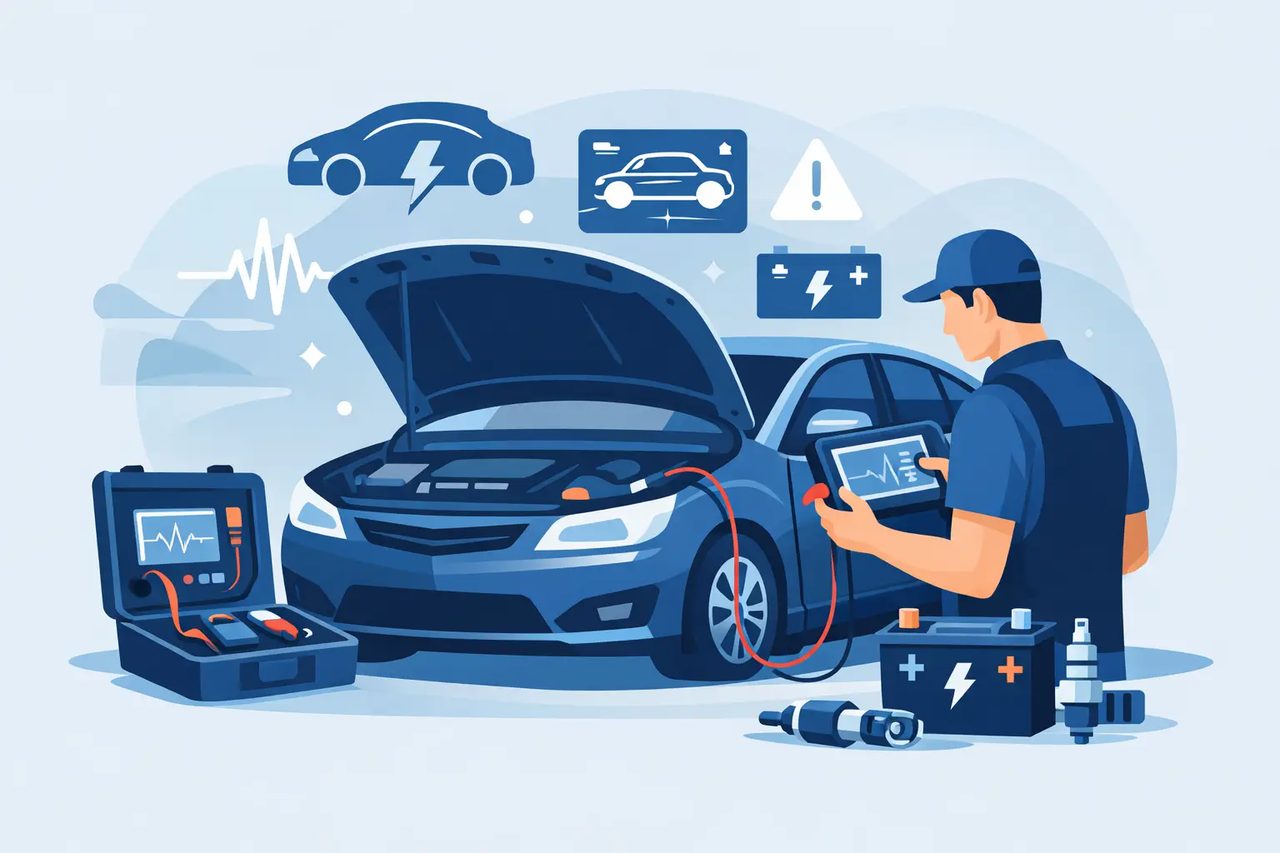
A vehicle that will not start on a busy Houston morning is not always dealing with a bad battery. A weak connection, failing alternator, damaged wire, blown fuse, or module communication issue can create nearly identical symptoms. This car electrical diagnostic repair guide explains what drivers can safely check, what a proper diagnosis involves, and when it is time to bring the vehicle to a qualified repair shop.
Modern vehicles depend on electrical systems for far more than starting. The battery, charging system, starter, lighting, power windows, A/C controls, sensors, cameras, safety systems, and engine computer all need clean, reliable power. Guessing at the failed part can waste money and leave the real problem unsolved. Accurate testing comes first.
Common Signs of an Electrical Problem
Electrical trouble does not always arrive as a total no-start. Sometimes it begins with small changes that are easy to ignore until the vehicle leaves you stranded. Slow cranking, dim headlights at idle, an illuminated battery light, flickering dashboard lights, and intermittent power accessories are all reasons to have the system checked.
Pay attention if your vehicle needs frequent jump-starts, even after the battery has been replaced. A new battery cannot correct a charging problem, a parasitic battery drain, corroded terminals, or an issue in the starting circuit. Likewise, replacing an alternator without confirming the alternator has failed can turn a straightforward repair into an unnecessary expense.
Other warning signs include burning odors near wiring, repeatedly blown fuses, power locks or windows that work only occasionally, warning messages on the dash, or an engine that cranks but will not start. Some of these conditions affect convenience. Others can affect visibility, charging, braking warnings, airbag systems, or the vehicle’s ability to run safely.
Car Electrical Diagnostic Repair Guide: Start With the Basics
A careful diagnostic process follows a sequence. The goal is not simply to find a part that looks suspicious. It is to locate the point where voltage, ground, signal, or communication is being lost.
Check the battery condition and connections
The battery is the starting point, but it should be tested rather than judged by age alone. A battery may show enough voltage at rest yet drop too low when the engine is cranked. Technicians perform a load or conductance test to see whether it can actually deliver power under demand.
Battery terminals also matter. Loose clamps, corrosion, damaged cables, and poor grounds can restrict current flow. White, blue, or green buildup around the terminals is a common clue, but not every connection problem is visible. A voltage-drop test can reveal resistance inside a cable or connection that looks fine from the outside.
For drivers checking at home, make sure the ignition is off before looking at the terminals. Do not bridge battery terminals with tools, and do not disconnect a battery on a late-model vehicle without understanding the possible effects on memory settings and electronic modules.
Confirm the charging system is doing its job
Once the engine starts, the alternator should replace the energy used by the starter and support the vehicle’s electrical loads. A battery warning light can indicate a charging issue, but the light alone does not identify the cause. The problem could be the alternator, drive belt, wiring, fuse, battery sensor, or computer-controlled charging circuit.
A technician checks charging voltage and current output under different conditions, including with headlights, blower motor, rear defroster, and other accessories operating. Many newer vehicles use smart charging systems, so a simple voltage reading does not always tell the complete story. Manufacturer specifications and scan-tool data may be necessary.
Test the starter circuit when cranking is the problem
If you turn the key or press the start button and hear one click, rapid clicks, or no sound at all, the starter circuit needs to be tested. The cause may be a weak battery, poor cable connection, failed starter, relay, ignition switch, neutral safety switch, clutch switch, or immobilizer issue.
This is where symptoms can be misleading. Rapid clicking often points to insufficient battery power, while a single solid click may suggest a starter problem. Still, testing is the only dependable answer. A professional can verify whether the starter is receiving the proper power and ground before recommending replacement.
Why Fuses Are Only Part of the Answer
A blown fuse is a warning, not a complete repair. Fuses protect circuits by opening when current exceeds a safe level. Replacing the fuse may restore operation temporarily, but if it blows again, there is likely a short circuit, damaged component, pinched wire, or overloaded circuit.
Never install a fuse with a higher amperage rating just to keep it from blowing. That can allow wiring to overheat and create a serious fire risk. The proper repair is finding why the fuse failed and correcting the underlying issue.
Electrical faults are often connected to recent events. Water intrusion after heavy rain, rodent damage, collision damage, aftermarket radio or remote-start installation, and work performed near the battery or dashboard can all affect wiring or connectors. Mentioning those details helps the technician narrow the testing process and save time.
Finding Battery Drains That Happen Overnight
A parasitic draw occurs when something continues using power after the vehicle is turned off. Small draws are normal because modules may stay awake briefly after shutdown and systems such as alarms retain memory. The issue occurs when the draw remains too high long enough to drain the battery.
Symptoms include a vehicle that starts normally after driving but has a dead battery the next morning, or a battery that repeatedly fails despite testing good. Common causes include a glove box or trunk light staying on, a stuck relay, malfunctioning module, charging port accessory, dash camera, amplifier, or wiring issue.
Diagnosing a battery drain takes patience. The vehicle may need time for its computer modules to enter sleep mode before testing begins. A technician uses an ammeter, fuse testing methods, wiring diagrams, and scan data to isolate the circuit responsible. Pulling fuses at random can wake modules back up and lead to inaccurate results, which is why this job is usually best left to a shop.
When Scan Tools Matter
A dashboard warning light often means the vehicle has stored diagnostic trouble codes. Reading a code is useful, but a code is not an automatic instruction to replace a part. For example, a low-voltage code may be caused by a weak battery, damaged ground, charging fault, or wiring problem rather than a failed control module.
Professional diagnostics combine scan-tool information with hands-on electrical testing. Technicians review codes, live data, freeze-frame information, module communication, wiring diagrams, and manufacturer test procedures. They then confirm the suspected failure with a meter, test light, scope, or circuit load test as needed.
This approach matters especially for no-starts, check engine lights, ABS warnings, airbag lights, A/C control failures, and post-collision electrical concerns. A vehicle can have several codes at once because one poor power or ground connection affects multiple systems.
Repairs That Should Not Wait
Some electrical concerns can be scheduled soon, such as an intermittent window switch or a weak radio display. Others deserve prompt attention. Schedule service quickly if you smell burning insulation, see smoke, have headlights that cut out, experience repeated fuse failures, receive airbag or brake system warnings, or notice severe battery corrosion or swelling.
If the vehicle stalls while driving, the battery light stays on, or electrical power fades while the engine is running, pull over safely as soon as possible. Continuing to drive can leave you without lights, power steering assistance on some vehicles, or enough power to restart.
At Sam Auto Repair & Collision, electrical diagnosis is handled with the same practical approach used for mechanical and collision-related repairs: inspect the concern, test the system, explain the findings clearly, and recommend the repair that addresses the actual cause. That is especially valuable when a vehicle has multiple warning lights or damage that may have affected wiring, sensors, lights, or charging components.
What to Tell Your Repair Shop
Clear details help speed up electrical diagnosis. Explain when the problem happens, whether it occurs only when the engine is cold or hot, what warning lights appear, whether recent repairs or battery replacement were performed, and whether the vehicle was in an accident or exposed to water.
Also mention any aftermarket accessories, including phone chargers, alarm systems, audio equipment, lighting, or dash cameras. These additions are not automatically the cause, but they can change how a circuit behaves. If possible, take a photo of warning messages before they disappear.
Electrical repairs can range from cleaning a terminal to tracing a damaged harness or programming a replacement module. The right repair depends on the test results, the vehicle’s age, and the condition of the related components. Getting an accurate diagnosis early is usually the best way to protect your budget, avoid repeat breakdowns, and keep your vehicle ready for work, school runs, and the road ahead.